
Chercheuse principale

Heike Härting is Associate Professor of English in the Department of Literatures and Languages of the World at the Université de Montréal. She is the founder and co-director of the Research Center of Planetary Cultural and Literary Studies/ Centre de recherche des études littéraires et culturelles sur la planétarité (CELCP) at the Université de Montréal. She is also the principal investigator of a large research team grant on “Cultural and Literary Planetary Studies: Practice, Epistemologies, and Transformative Pedagogies,” funded by the Fonds de Recherche du Québec Société et Culture (FQRSC, 2021-2025). This project has developed a research framework for planetary literary and cultural studies and organized various SSHRC-funded international conferences and events which helped outline and consolidate the nascent field of planetary literary and cultural studies. The areas of her academic training include globalization and postcolonial literary studies with a critical focus on contemporary African and Canadian literatures, and representations of global violence and of the Anthropocene. The latter is reflected in her earlier work on cosmopolitan film theory (with the support of a Alexander von Humboldt TransCoop Research Grant), and the narrative aesthetics and politics of metaphor in contemporary Caribbean and Canadian fiction (see, her special issues on “Canadian Peacekeeping Narratives, Security and the Canadian Imaginary” [co-edited with Smaro Kamboureli] of University of Toronto Quarterly, 2009; and on “Narrative Violence: Africa and the Middle East” [co-edited with Nouri Gana] of Comparative Studies of South Asia, Africa, and the Middle East, 2008). Her current research interests focus on the planetary health humanities (see, her essay on “Speculative Health Futures: Contemporary Canadian Health Policies and the Planetary Health Commons in Larissa Lai’s The Tiger Flu” in Studies in Canadian Literature, 2024, and her collective volume Planetary Health Humanities and Pandemics [co-edited with Heather Meek], Routledge, 2024). In this context, she holds a SSHRC Insight Grant for her research project “Viral Conjunctures: Pandemics and Planetary Health Narratives” (2023-2027). She is also the co-editor of a special issue of Transtext(e)s Transcultures 跨文本跨文化 on “Im/mobilities in the Planetary Now: Migration and Diaspora in World Cinema” (with Johannes Riquet, 2023).
Cochercheurs et cochercheuses

Isaac Bazié est professeur titulaire au Département d’études littéraires à l’Université du Québec à Montréal, chercheur régulier à FIGURA, le Centre de recherche sur le texte et l’imaginaire, membre de l’Observatoire de l’Imaginaire Contemporain (OIC) et du Centre de Recherche des Études Littéraires et Culturelles sur la Planétarité (CELCP) à l’Université de Montréal. Il a assumé plusieurs directions dont celle du Département d’études littéraires de 2013 à 2015. Il est détenteur d’un doctorat en littérature romane et comparée de l’Université de Bayreuth (Allemagne). Son enseignement et ses publications portent sur les théorisations et les figurations de l’Afrique dans son rapport au monde, les littératures africaines et le canon de la littérature mondiale, les théories de la lecture et de la réception, le rapport entre littérature, violences (Auschwitz, Rwanda etc.), mémoires et identités. Son livre Dɔnko Sous-titre: Études culturelles africaines a été publié en 2019 en collaboration avec Salaka Sanou. Il est le fondateur de la revue Afroglobe, co-fondateur et directeur actuel du Laboratoire des Afriques Innovantes (LAFI).

Domenico A. Beneventi is Professor of English and Comparative Literature at Université de Sherbrooke, Canada. His research interests and publications focus on Canadian and Québécois literatures, urban writing, gender and queer studies. He is co-editor of Contested Spaces, Counter-narratives, and Culture from Below in Canada and Québec (UToronto Press 2019), La lutte pour l’espace: Ville, performance, et culture d’en bas (ULaval Press, 2017). He heads the FRQSC-funded research team Équipe de recherche en études queer au Québec.

Raphaël Canet enseigne la sociologie au CEGEP du Vieux Montréal. Il a aussi été professeur à l’École de développement international et mondialisation de l’Université d’Ottawa (2008-2017). Titulaire d’un doctorat en sciences sociales de l’Université de Paris-IV Sorbonne (2002), il a co-coordonné l’organisation du Forum social mondial 2016 de Montréal. Membre du Conseil international du FSM, il participe aux forums sociaux depuis 2004. Il a coordonné l’organisation du premier Forum social québécois (2007) puis, de 2008 à 2015, il a encadré les Collectifs de la société civile québécoise dans les forums internationaux. Il est membre du Conseil d’administration du Mouvement Démocratie Nouvelle (MDN) ainsi que du comité de rédaction de la revue Possibles. Auteur de plusieurs ouvrages et articles scientifiques il a notamment publié Nationalisme et société au Québec (Athéna éditions, 2003), L’altermondialisme : forums sociaux, résistance et nouvelle culture politique (Écosociété, 2010), Passer de la réflexion à l’action. Les grands enjeux de la coopération et de la solidarité internationale (M. Éditeur, 2013), et tout récemment Altermondialismes. Justice sociale et écologique dans un monde globalisé, (Presses de l’Université d’Ottawa, 2022). Il vient aussi de diriger trois numéros de la revue Possibles, soit Hors Système : Communautés autonomes, expériences de la liberté, en collaboration avec Samuel Raymond (automne 2021), L’Éveil, Paroles Wokes et débats, en collaboration avec Francis Dupuis-Déri (été 2022) et Pour une autre suite du monde, en collaboration avec Léo Palardy (automne 2022).

Simon Harel est professeur titulaire au Département de littératures et de langues du monde de l’Université de Montréal. Il est le directeur du Laboratoire sur les récits du soi mobile, codirecteur du Centre de recherche des études littéraires et culturelles sur la planétarité, de même que membre fondateur de L’organon (lorganon.ca) un espace de recherche-création sur le soin et l’accompagnement. Directeur d’ouvrages collectifs, auteur de nombreux essais, écrivain, responsable de numéros de revues, il a plus de cinquante publications à son actif. Il prépare une série de publications sur la voix cruelle et l’enchantement dans l’œuvre de Bob Dylan. Il publiera en 2025 aux Presses de l’Université Laval un essai intitulé L’affaire Naipaul. Enquête sur une femme discrète, Patricia Hale, conjointe de l’écrivain, il a publié en 2024 plusieurs volumes collectifs : La réinvention des corps. Une incursion organique dans les domaines de la culture et de la médecine (avec Karine Gendron, Catherine Mavrikakis et Pascale Millot); Femmes passe-murailles. Écrits et voix de prison (avec Mira Missirian et Valentina Pancaldi ). Aux Éditions Héliotrope, une fiction sur le quatrième anniversaire de l’annonce de la COVID19, Ça ne tourne plus rond (avec Karine Gendron, Catherine Mavrikakis et le Docteur Jean-Pierre Routy).

Yasmin Jiwani is a professor in the Department of Communication Studies at Concordia University, Montreal, Canada. She is the author of Discourses of Denial: Mediations of Race, Gender and Violence published by UBC Press (2006), and co-editor of Girlhood: Redefining the Limits, published by Black Rose Books (2006). She was also co-editor of the International Journal on Media and Cultural Politics. More recently, she co-edited a special issue of the Global Media Journal (Canadian edition) on Islam and the Media (2009).

Catherine Leclerc est professeure au Département de langue et littérature françaises depuis 2005. Elle enseigne la traduction et les littératures canadiennes et québécoises, surtout celles des minorités linguistiques. Intitulée « Des langues en partage? Cohabitation du français et de l’anglais en littérature contemporaine », sa thèse de doctorat se penchait sur des textes littéraires qui font coexister les langues de manière si intense qu’ils mettent en question la notion de langue du texte servant à catégoriser les littératures. Depuis, elle a continué de s’intéresser au plurilinguisme littéraire, puis à la traduction de cet hétérolinguisme. Ses recherches actuelles portent sur la chanson hétérolingue contemporaine, de même que sur l’écriture et la traduction inclusives.

Catherine Mavrikakis est professeure de littérature en recherche-création au Département des littératures de langue française de l’Université de Montréal. Écrivaine et co-titulaire de la Chaire McConnel-Université de Montréal sur les récits du don et de la vie en contexte de soins ( 2019-2023), elle a publié de nombreux romans, essais et textes de fiction. Dans ses travaux de recherche, elle s’intéresse notamment aux écrits sur le deuil, la folie, la maladie et le sida dans un contexte mondial.

Heather Meek is Associate Professor of English in the Department of Literatures and Languages of the World at Université de Montréal. Her research explores the intersections of literary and medical cultures in the long eighteenth century, with a particular focus on the works of women and physician writers. Her publications include investigations of Frances Burney’s early nineteenth-century mastectomy narrative (in Literature and Medicine, 2017); Samuel Richardson’s relationship to the medical milieu of his time (in Samuel Richardson in Context, Cambridge UP, 2017); medical discourse and the rise of the novel (in Literature and Medicine: The Eighteenth Century, Cambridge UP, 2021); eighteenth-century vocabularies of illness (in BMJ: Medical Humanities, 2022); and representations of blood and bloodletting (in Journal for Eighteenth-Century Studies, 2023). Her monograph, Re-Imagining Illness: Women Writers and Medicine in Eighteenth-Century Britain (McGill-Queen’s University Press), appeared in November 2023. With Heike Härting, she has completed and published an edited collection, Planetary Health Humanities and Pandemics (Routledge).


Karoline Truchon is professor of digital communications in the Department of Social Sciences at UQO (Université du Québec en Outaouais). Karoline is also the scientific director of Amplifier, a collective that brings together researchers from several disciplines and content producers around storytelling projects. As a photographer of little highlights of everyday life, Karoline also likes to believe that she invented #urbanpoetry.
Coordination
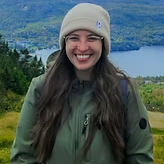
Rima Ghazouani is a PhD candidate in English Studies at Université de Montréal. She holds a bachelor’s degree in English Language, Literature, and Civilization from the Institut Supérieur des Sciences Humaines de Tunis and a master’s degree from Université de Montréal, where her research focused on history, memory, and trauma. Both her master’s and PhD studies were fully funded by a national excellence scholarship awarded by the Tunisian government. Her ongoing research is interested in the intersections of planetary studies, animal studies, and postcolonial studies within African and African diasporic fiction. Currently, Rima serves as the coordinator of the research team “Cultural and Literary Planetary Studies: Practice, Epistemologies, and Transformative Pedagogies” funded by the Fonds de Recherche du Québec Société et Culture (FQRSC, 2021-2025).